Abstract
For decades, airline profitability has been significantly bolstered by Investment in Revenue Management (RM) systems. These strategic systems, leveraging demand forecasting and seat inventory control, reliably generate 4% to 8% in incremental revenue by optimizing long-term network performance. However, this strategic focus inherently creates a tactical gap: while the strategy is optimal in aggregating over thousands of flights, it is frequently suboptimal for any single, individual flight departure.
This paper introduces the concept of Beyond Revenue Management (BRM), a paradigm shift that complements, rather than replaces, traditional RM. BRM is a suite of tactical tools and processes designed to identify and correct the inevitable suboptimal decisions made by the strategic RM system for specific flights. By addressing overprotection and under protection of inventory in real-time, BRM empowers airlines to recover lost revenue, defend against competitor actions, and respond to unforeseen market shifts, moving from a purely strategic game of probability to one of tactical precision.
1. Introduction: The Inherent Limitation of Strategic Revenue Management
Since the late 1980s, airline Revenue Management has been a cornerstone of commercial aviation strategy. By forecasting demand and dynamically controlling seat inventory, airlines can effectively « protect » seats for late-booking, high-yield business travelers while selling earlier, lower-fare seats to price-sensitive leisure passengers. The underlying principle is a probabilistic optimization, akin to a sophisticated game of dice.
The Dice Analogy: The optimal long-term strategy in a dice game is to always bet on the number seven, as it has the highest probability of occurring. Over thousands of throws, this strategy is profitable. However, on any single throw, the outcome is just as likely to be a two or a twelve, resulting in a loss. Airlines live this reality daily:
- Their RM systems are calibrated to « bet on seven » across their entire network.
- For most flights, this works well.
- But for a significant minority of flights, those experiencing unexpected demand surges, competitor price drops, group bookings, or schedule disruptions, the outcome is a « two » or a « twelve, » leading to either: Spoilage: Empty seats on a flight because too many were protected for high-yield demand that never materialized. Spill: Turning away high-yield passengers because seats were sold too early to low-yield demand, with the forecast underestimating late-booking volume.
Airlines have historically accepted these losses as the « cost of doing business » with a statistically driven system. However, in today’s hyper-competitive and data-rich environment, acceptance is no longer a viable strategy.
2. The Problem: The Tactical Gap in Day-of-Departure Execution
The core issue is that traditional RM is a strategic pre-departure planning tool. It makes decisions for weeks and days in advance based on forecasts. Once the flight enters its final days or hours, the RM system’s influence often wanes, and its pre-set controls can become rigid and misaligned with real-time market conditions.
This creates a Tactical Gap—the period where the flight’s revenue potential is no longer being actively optimized, and suboptimal inventory allocations are locked in. Common scenarios include:
- Over-protection for High-Yield Demand: A flight is protected for business demand, but a key corporate account cancels a block of seats at the last minute. The RM system may not react to this situation because it is too late to sell more seats to leisure customers without dilution revenue from Business customers thus leaving seats empty at departure that could have been sold to leisure passengers.
- Under-protection for High-Yield Demand: A last-minute event (e.g., a conference, a competing flight cancellation) creates a surge in high-yield demand, If the Revenue Management System did not anticipate this surge in advanced and did not protect enough seats for late coming high value passengers, the booking classes will be already closed or heavily restricted, causing spill to competitors.
- Competitor Price Actions: A competitor slashes prices on a parallel route, making your protected inventory overpriced and uncompetitive. The RM system may not trigger a tactical price response.
- Group & Disruption Impact: A small group booking or a cancellation of a connecting flight can alter the demand profile in a way the forecast did not anticipate.
These are not failures of the RM system; they are inherent limitations of any strategic tool such as RM designed based on probabilistic expectations for long-term success.
3. The Solution: Introducing Beyond Revenue Management (BRM)
Beyond Revenue Management (BRM) is the framework for closing the Tactical Gap by optimizing inventory after the traditional Revenue Management system has completed its work. It is a complementary, downstream layer of intelligence and action that operates on a fixed inventory pool, focusing exclusively on tactical recovery and revenue generation in the final stages before departure.
Core Philosophy: BRM does not seek to replace or integrate with the core RM system. Instead, it acts as a parallel, post-processing system. It accepts the seat allocations and pricing decisions made by the RM system as a starting point, and then innovatively manipulates the existing passenger manifest to create new revenue opportunities without altering the RM’s original strategy. Closer integration, however, with the airlines’ RMS should increase the expected benefits from BRM
The independent BRM framework is built on three pillars:
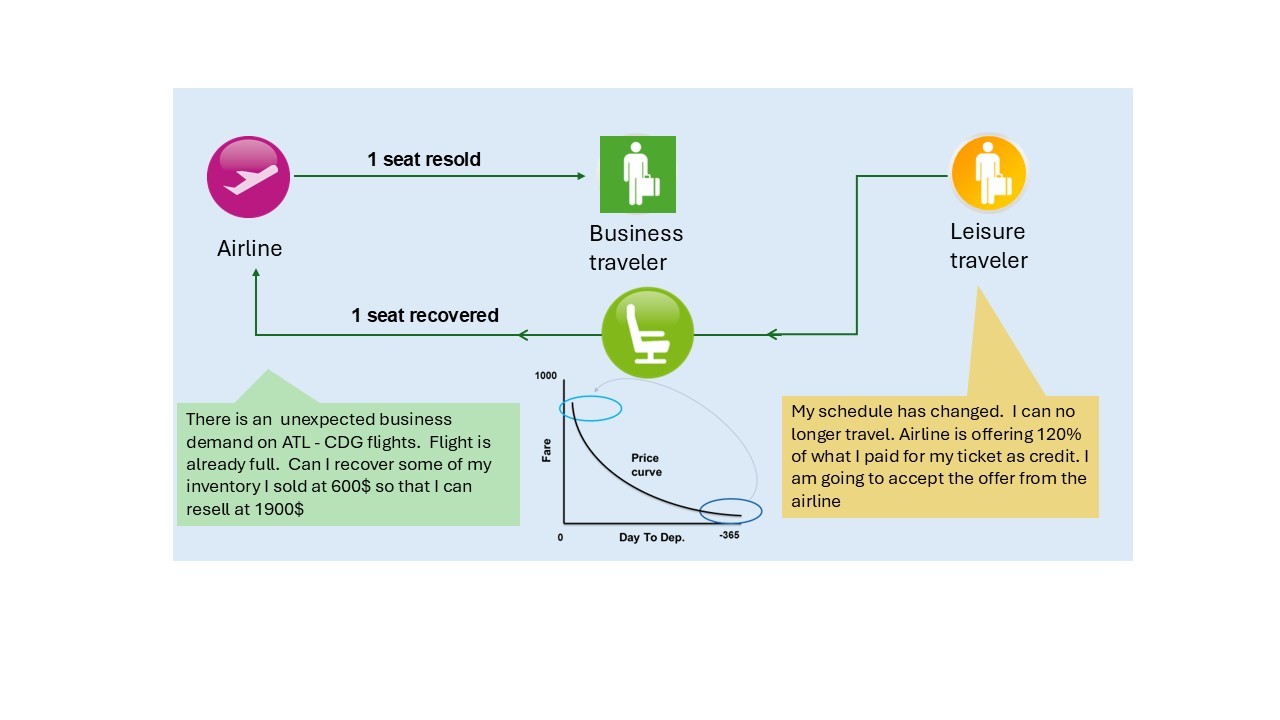
Pillar 1: No-Show collection & Inventory Recovery Since BRM cannot influence the RM system’s seat protection, it focuses on optimizing the seats that are already sold. By incentivizing customers to announce their voluntary No-show in advance (customers who are facing an unexpected personal event), you build a stock you can use in the future. Fairlyne’s system considers the entire fight to identify the optimal number of seats from No-show to recover. This approach is what we call, in this paper, tactical optimization to maximize revenue by reducing no show, replacing low value passengers with higher fare and improving demand forecast for the future, thus increasing expected RMS revenue. In parallel, it follows a customer-first approach by addressing a well-known traveler pain point: losing money when plans change and being stuck with a non-refundable booking.
Pillar 2: Proactive Inventory Monetization After No-shows have been leveraged, the platform uses advanced data analytics to identify number of passengers and their price levels already paid to retrieve and to be resold at higher price by analyzing historical booking data, passenger travel patterns, and other relevant factors. Once a pool of candidate tickets is identified, BRM enables proactive monetization by running two key actions:
- Repurchase or Partial Refund Offers: initiate targeted offers to the identified passengers, proposing to repurchase their ticket for voluntarily giving up their seat or offer a new option to travel earlier or later. This transaction is a win-win: the passenger receives a gratification, and the airline converts a potential loss and lesser value tickets into a higher value recovered assets.
- Inventory Liberation & Resale: The seat recovered through this process is now liberated back into the active inventory pool. Crucially, this seat can now be resold. Freed from the original booking class restrictions, it can be offered at a significantly higher price to late-arriving, high-yield business customers, precisely the demand the RM system was originally trying to protect for.
- Next step could be to recommend strategies to sell expected empty seats later in the sales cycle without diluting the expected revenue from higher value business passengers
Pillar 3: A Closed-Loop, Non-Invasive System The entire BRM process is designed to function without any integration into the core RM or reservation systems, making it fast to implement and risk-free to the primary revenue strategy. However, if needed, BRM can also be integrated into the airlines’ RM system to enhance the decision-making process by utilizing unexpected changes in the booking existing inventory and demand forecast levels.
- No System Overrides: BRM requires no changes to booking classes, fare rules, or availability controls set by the RM system.
- Direct Customer Engagement: The monetization process happens through direct customer interaction (e.g., email offers, app notifications), bypassing complex system integrations.
- Pure Incremental Revenue: Every seat re-sold through this recovered inventory represents pure, incremental revenue that would have otherwise been lost.
4. The BRM Suite in Action
An effective BRM strategy leverages its unique, non-invasive solutions:
- No-shows collect: The core engine identifies the monetizable opportunity within the existing passenger list.
- Automated Offer Management: Systems to make tailored repurchase or refund offers to customers and manage their acceptance.
- High-Yield Resale Channels: Processes to swiftly return the recovered seat to the market through channels frequented by last-minute business travelers.
Illustrative Scenario: The Silent No-Show
- Sales opening: No-show web site to request to resale is open. Every customer who faces an agenda disruption can request a resale of his booking. Mr Smith and Mr François, due to an agenda issue, request to resale their non-refundable booking.
- Day -15: The RM system has closed lowest-fare classes on Flight 101, protecting seats for high-yield demand.
- Day -10: Fairlyne’s BRM system analyzes the flight situation and analyze the flight in advance on his forecast. Mr. Smith and Mr. François PNR who request 20 days ago to resale are recovered in the inventory by canceling their booking. Then, Mr. Smith and Mr. François receive a partial compensation with a voucher to generate retention & loyalty.
- Day -6: the flight is still in advance on his forecast. An automated offers are sent to targeted pax: Mr. John: « We will give you a 120% travel credit if you voluntarily cancel your flight tomorrow or we propose you xx$ to accept to change your flight for one in this list”
- From Day-4 : Spill is avoided by the additional capacity found earlier.
- Result: seats are instantly freed. The airline’s sales team now markets these available seats on Flight 101 at a premium price. Revenue Outcome: The airline paid credit but sold the same seat for a much higher cash fare to a new business passenger, generating significant net incremental revenue. Without BRM, Mr. Smith and Mr. François would have been a no-show, and the seat would have flown empty, and Mr. John would have shown up on this flight and travel at much lower revenue to the airline.
About Fairlyne
Fairlyne provides airlines with the intelligent Beyond Revenue Management platform needed to close the tactical gap. Our solution delivers real-time anomaly detection, prescriptive analytics, and seamless execution tools that empower revenue teams to recover lost revenue and maximize the potential of every flight departure. Contact us to learn how we can help you build your BRM capability.